
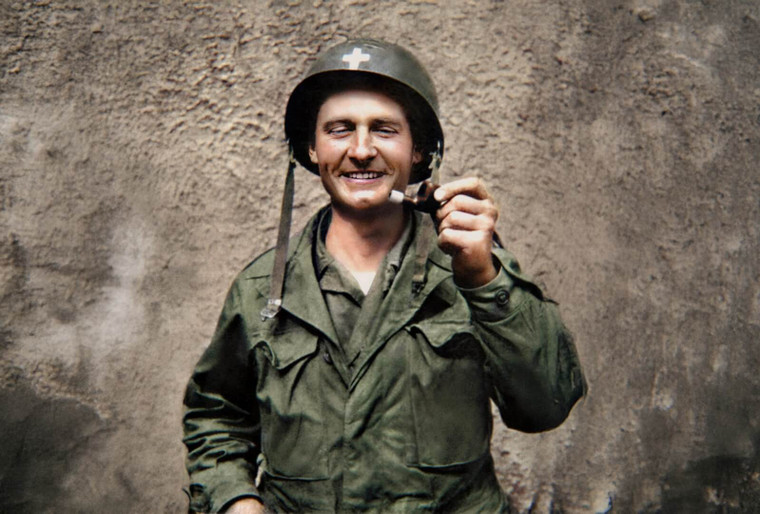
Captain Emil J. Kapaun—A Shepherd in Combat Boots
Posted by Warrior Poet Society on Jan 2nd 2026
When history reserves its highest honors for those who embody service without limit, sacrifice without hesitation, and courage that transcends the battlefield, it finds a strong example in Captain Emil J. Kapaun.
Similar to our Warrior Poet Profiles, but hitting a bit closer to home, we want to highlight the lives of brave Americans who exemplify or—in many cases—exemplified the ethos of what it means to be a warrior poet.
Warrior poets are those rare souls whose minds are disciplined, whose hearts burn to protect others, and whose actions reflect both mercy and severity in equal measure. We honor the lives and legacies of those who have been awarded our nation’s highest military honor for gallantry above the call of duty.
Today, we’re looking at the heroism of Captain Emil J. Kapaun—a chaplain, a shepherd, and a warrior whose faith and valor became inseparable on the killing fields of Korea.
We did not choose Kapaun because he was flawless. He was human—vulnerable, compassionate, and simple in origin. What sets him apart is not grand strategy or sweeping conquest, but the depth of his spiritual courage: the way he chose to give his life for others.
From a farm in Pilsen, Kansas, Emil Joseph Kapaun’s life began with humble roots. Born in 1916, he grew up working the fields, tending livestock, and learning the kind of humble grit that often foreshadows extraordinary character.
He felt called to serve both God and country, studying classics and philosophy before entering Kenrick Seminary. Ordained a Roman Catholic priest in 1940, Kapaun could have chosen the quiet life of parish ministry. Instead, he saw another mission field: the battlefield itself.
In 1944, he joined the U.S. Army Chaplain Corps, serving first in the Burma–India theater in World War II. After the war, he pursued further education, only to return to service in 1949 as the world again erupted into conflict.
When the Korean War began, Kapaun deployed with the 1st Cavalry Division to the front lines, not as a combatant, but as a shepherd in combat boots. He traveled tirelessly among the troops—riding jeeps and bicycles under fire—bringing comfort, sacraments, and encouragement. He celebrated Mass wherever he could, even on the hood of a jeep on the frontlines (you’ve probably seen this famous photograph).
His valor was not abstract or symbolic; it was visceral. In November 1950, near Unsan, as Chinese forces attacked and threatened to overwhelm his battalion, Kapaun repeatedly dodged heavy enemy fire to aid the wounded and dying, saving the lives of over 40 soldiers. Ordered to retreat with able-bodied troops, he refused to leave behind the injured, choosing instead to stay with them—fully aware that capture was inevitable.
Captured by Chinese forces, Kapaun endured seven brutal months in prisoner-of-war camps. As starvation, disease, and despair ravaged his fellow prisoners, Kapaun became a beacon of hope. He shared his scant food, built latrines and fires against orders, smuggled medicine to the sick, mediated disputes, and led prayers.
He refused multiple chances to escape, choosing always to remain with the suffering. When his strength finally gave out—claimed by malnutrition, pneumonia, and the cruelty of captivity—he died in May 1951, at just thirty-five years old.
For his acts of selfless gallantry, Kapaun was posthumously awarded the Medal of Honor—our nation’s highest military decoration.
Today, the Catholic Church has declared him Venerable, a significant step toward potential sainthood—a recognition of his life of heroic virtue and self-sacrificial love.
What Captain Kapaun Teaches Us
Kapaun’s heroism did not rest in the strength of his arms or the precision of his tactics. His victories were not counted in territory gained but in lives saved, comforted, and inspired. He exemplifies a truth Warrior Poets know well:
True courage is not the absence of fear—but the choice to stand with others despite it.
If you seek to be a better leader, a more courageous soul, an influence for good in a world that often demands compromise, look to Emil J. Kapaun—the priest-soldier whose life remains a testament to the warrior poet way.
Remember, Train Hard, Train Smart, and strive toward the warrior poet way.