
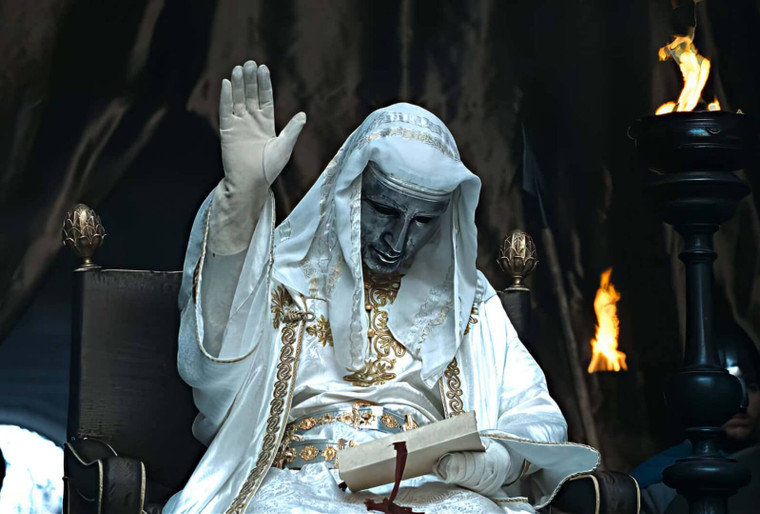
Warrior Poet Profile: King Baldwin IV—The Leper King
Posted by Warrior Poet Society on Dec 5th 2025
History often crowns men with titles they did not ask for. But few kings have ever carried a title as heavy—nor as heroic—as the Leper King. And so King Baldwin IV of Jerusalem takes his rightful place among our “Warrior Poet Profiles,” a series dedicated to men whose courage, intellect, and sacrificial love earned them a place in history’s hall of honor.
For those new to these profiles, a warrior poet is someone whose mind is disciplined, whose heart is stirred to protect others, and whose hands are skilled in the hard business of violence. A warrior poet is not perfect, but he is principled. And Baldwin IV is one of the clearest examples.
I did not choose Baldwin because he was a conqueror. He was not a brilliant destroyer like Alexander, nor a king who chased empire for glory.
No, Baldwin was something rarer. He was a child who became a king, a king who became a legend, and a legend who became an inspiration, not because of what he conquered, but because of what he endured.
Baldwin IV stands apart because he led men to war while slowly being consumed by a disease that should have taken his life long before he ever took the crown.
A Boy Who Should Have Been Broken
At the age of nine, Baldwin was diagnosed with leprosy. In most eras, this diagnosis was equivalent to a death sentence. It carried not only physical agony, but also social exile and spiritual stigma. The body would deteriorate, the nerves would die, and the person would be pushed away from society.
But Baldwin refused exile.
Instead, under the guidance of his tutor, Archbishop William of Tyre, he sharpened his mind. When illness tried to imprison him, he turned to study. When pain tried to control him, he learned discipline. When despair threatened him, he clung to purpose.
Leprosy could take his body, but it could not touch his will.
A King Who Chose the Front Lines
When Baldwin ascended the throne at age thirteen, Jerusalem was perched on the edge of annihilation. Saladin—one of the greatest commanders of the medieval world—was tightening his grip on the Holy Land. Everyone expected the young king to be a figurehead, a placeholder, a tragic symbol.
Instead, he rode to war.
At the Battle of Montgisard in 1177, Baldwin—only sixteen years old and already losing the use of his hands—faced a vastly superior Muslim army. Saladin commanded thousands. Baldwin commanded perhaps a few hundred knights and the ragged remnants of his infantry.
It should have been a slaughter.
Instead, it became one of the most miraculous victories in Crusader history.
Baldwin ordered his standard raised high and charged at the head of his knights. Too weak to even hold the reins, he had his men tie him to his horse. The Leper King led from the front—where the danger was greatest, where fear was loudest, and where leaders are either made or unmade.
Saladin’s army broke.
It was said later that Saladin fled the battlefield “barely escaping with his life,” and that he never forgot the terror of that day—a sick, dying boy striking fear into the heart of an empire.
A Mind for Diplomacy, a Heart for His People
Baldwin’s greatness was not limited to the battlefield. He was a political tactician, balancing rival factions within his own court while managing delicate diplomacy with Saladin. He knew that the Kingdom of Jerusalem could not survive on might alone. He needed allies, strategy, and restraint.
Where others sought reckless war, he sought stability.
Where others played at power, he carried its true weight.
Where others grappled for the crown, he fought every day simply to live long enough to protect his people.
A Legacy of Courage in the Face of Certain Defeat
Baldwin IV reigned for only eleven years. By the end, he was nearly blind, his limbs failing, his body collapsing. Yet he continued to rule. Continued to plan. Continued to fight.
He outlived every prediction.
His enemies respected him. His knights revered him. His people loved him.
And his legacy stands as one of the clearest examples of a Warrior Poet King—a man whose body was failing but whose spirit never bent.
What Baldwin IV Teaches Us Today
Strength is not the absence of weakness. Courage is not the absence of fear. Leadership is not the absence of pain.
Baldwin proved that the greatest victories are sometimes won not by overwhelming force, but by overwhelming resolve.
He teaches us that the warrior’s heart can beat inside a fragile body. He teaches us that heroism is measured in sacrifice, not lifespan. He teaches us that even when the world expects you to fall, you can choose to rise.
Remember, Train Hard. Train Smart. And know that true courage is forged not in power, but in perseverance.