
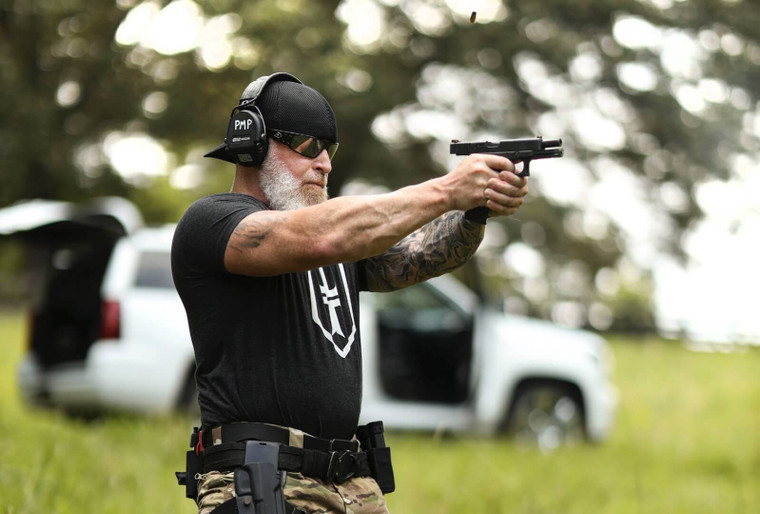
Cadence: The Truth About Speed, Control, and What Your Shooting Is Really Telling You
Posted by Warrior Poet Society on Apr 17th 2026
In the world of shooting, cadence isn’t about looking cool, keeping time, or syncing your shots to your footwork. It’s not an engagement strategy. It’s not how you win a fight.
Cadence is a diagnostic tool, and if you understand it correctly, it will expose exactly where your shooting is breaking down.
Cadence Is a Tool—Not a Tactic
Let’s get this clear upfront: Cadence is a training tool, not an engagement strategy. In a real fight, you are not trying to shoot at a steady rhythm. You are trying to: See what you need to see to shoot what you need to shoot.
That’s it.
Speed is dictated by your ability to process information—not by some pre-set tempo.
But in training?
Now cadence can play a strong role.
Because when you deliberately shoot at a consistent rhythm—equal split times between shots—you create a controlled environment that allows you diagnose the faults in your skill and correct previously unseen or unrealized problems in your shooting.
Think of cadence like a warning system.
If everything is working correctly—your grip, your vision, your recoil management—you should be able to maintain a steady rhythm across a string of fire.
If you can’t?
Something is broken.
And cadence can tell you exactly where to start looking.
What Cadence Reveals
When your cadence falls apart, it’s usually not random. There’s almost always a cause and effect.
Here’s what it might be telling you:
1. Your Grip Is Failing
You fire a few rounds then suddenly pause.
Why?
Because your grip couldn’t hold up, and you had to readjust mid-string.
2. You’re Overdriving the Gun
You try to control recoil aggressively and end up dipping the muzzle low.
Now you have to stop, reset, and rebuild your sight picture.
3. Your Vision Is Wrong
If you start staring at your dot instead of staying target-focused, something subtle happens:
Your dot starts tracking high.
Now your hits degrade, and you’re forced to correct.
Again—cadence breaks.
Not because you “lost rhythm,” but because you couldn’t maintain visual discipline.
4. You Can’t Process the Sight Picture Fast Enough
At a proper cadence, every shot should be tied to a sight picture.
If you can’t keep up, you’ll hesitate.
That hesitation is data.
It means your visual processing and trigger work aren’t synced yet.
What Good Cadence Actually Means
When you can maintain cadence across a string of fire, here’s what it tells you:
• Your grip is stable
• Your recoil management is efficient
• Your vision is disciplined
• Your trigger press is consistent
In other words: Everything is working together.
Bringing It to the Range
Next time you’re training, try this:
• Pick a manageable pace
• Shoot a controlled string (4–6 rounds)
• Keep your split times even
Then pay attention. If your cadence breaks, don’t ignore it.
• Did your grip fail?
• Did your sights/red dot drift?
• Did your muzzle dip?
• Did your eyes lag behind the gun?
Every break in cadence is feedback. And feedback—used correctly—is how you get better.
Final Thought
Cadence isn’t about shooting like a metronome. It’s about revealing the truth. Because under pressure, you won’t magically perform better than your training. You’ll default to it.
Focus on the fundamentals, build consistency, and let cadence show you what you need to fix to get better.
Remember, Train Hard. Train Smart. And learn to read what your shooting is trying to tell you before the fight does it for you.